Monday, March 21, 2016

"The Divergent Series: Allegiant" Review

The official title of this film is The Divergent Series: Allegiant. Originally, there was supposed to be a Part 1 in there, but last September, Summit Entertainment and Lionsgate changed the titles, renaming part two, The Divergent Series: Ascendant.

The Hollywood Reporter said it was "likely" the change was because the films would expand on Veronica Roth's novel. Be honest. The Hunger Games: Mockingjay as a two-parter didn't bring in the profit Lionsgate wanted, so by changing the name, moviegoers are to think Allegiant is a stand-alone installment.

Don't be fooled. Not only isn't this its own story, it's barely half of one.

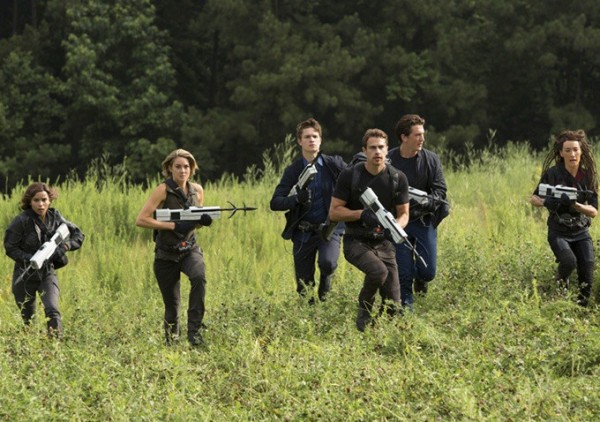
Jeanine (Kate Winslet) is dead, and Evelyn (Naomi Watts) has taken over. She orders the gates closed, to the dismay of Four (Theo James) and Tris (Shailene Woodley), who wish to find the Founders who set up the Chicago experiment. Evelyn holds trials for Jeanine's supporters, which devolve into mob-mandated executions (I got some chuckles out of the more enthusiastic extras, who screamed everything but "Give us Barrabbas!")

Tris and Four rescue Caleb, and along with Peter (Miles Teller), Christina (Zoe Kravitz), and Tori (Maggie Q) make a break for the gate, escaping to the Fringe, a radioactive wasteland so polluted, the rain is colored red (Raining Blood!)

They find the Founders, named the Bureau of Genetic Welfare. Their leader, David (Jeff Daniels), says Chicago's been monitored for centuries - the local kids ogle Four like a TV star - and finally, the experiment has produced a genetically "Pure" divergent person, a.k.a. Tris. 

So Chicagoans were divided into groups based on arbitrarily chosen moral traits. The hope was the factions would keep order (dubious at best), and they'd cross-breed to produce a perfectly divergent person. How does one empirically measure bravery or honesty to know if someone's a perfect blend? According to Allegiant, it's in the genes. Never mind that David doesn't explain any of this beyond his assertion. With all the pointless action, subplots, and characters, one would think this could be addressed. Guess we really had to find out if Four was going to get along with his new hard-ass commanding officer.

Where Jennifer Lawrence looks bored in The Hunger Games: Mockingjay - Part 2, Shailene Woodley's still energized. It's just a shame she has little to do. Most of her scenes consist of awkward, one-sided conversations with Four or David. There's barely any development outside of her being "the only one" who can fulfill the experiment/goal/prophecy.
Allegiant feels like busy work. We're watching characters run from soldiers, trek through desert, hack surveillance, hunt down rogues - a plethora of plot with little impact. The movie differs from other "Part Ones"in that it's filled with action, but is somehow more dull. It's not a matter of turning Allegiant and Ascendant into one two-hour movie, but boiling the plot to its essentials. With an Alex Garland or David Cronenberg - storytellers who've explored technology's relationship with sociology (Ex Machina and Videodrome, respectively) - at the helm, we'd have a tighter, more focused film.

As it stands, the movie's bogged down by a cluttered script, and Schwentke's direction, while glossy at times, reminds me too much of last year's Maze Runner: The Scorch Trials or Transformers (the cinematography, especially) to feel fresh.

This film's two hours, and it's a slog to sit through. This, and Hollywood's continued resistance to tell a trilogy in three movies leaves me unwilling to stick around for Ascendant. Consider this my jump-off point. If you're only a fan of the movies, just pick up the last book.

It'll be less expensive and less disappointing.

Thank you all for reading. I'm the Man Without a Plan, signing off.


Saturday, March 19, 2016

"Hardcore Henry" ADVANCE Review

We tout this word like candy, but Hardcore Henry is a game-changer, emphasis on "game."

Since 1993, the best video game movie is still Mortal Kombat. Doom and The House of the Dead fail to reach a 25 percent on Rotten Tomatoes, combined. Bioshock struggles to get green-lit, and the less we mention Super Mario Bros, the better.

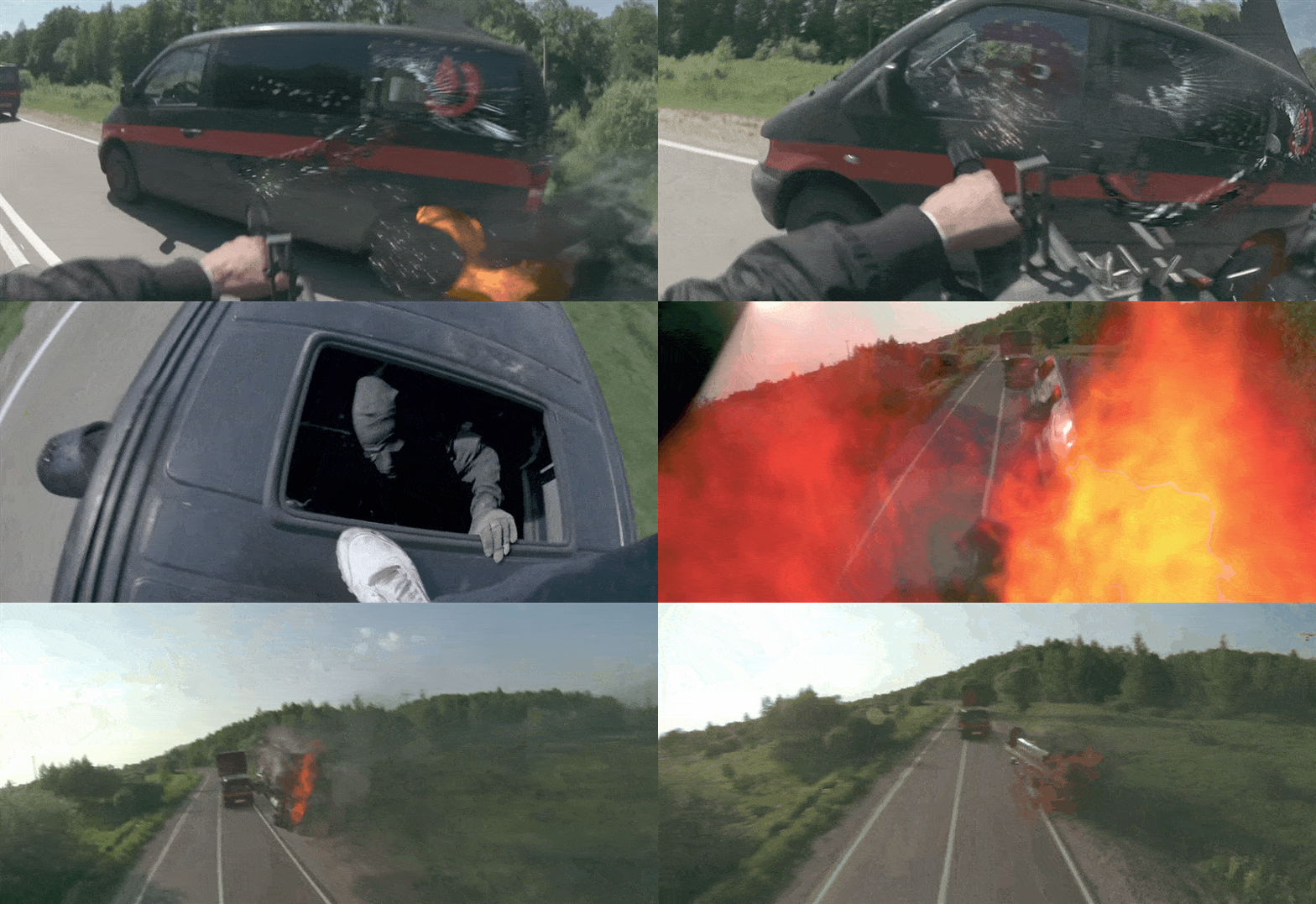
Hardcore Henry, while not based on a game, takes what's great about gaming - its immersion and momentum - and adapts it to film. The result is a gleeful orchestra of cars, shotguns, grenades, knives, and relentless, pulse-pounding action.

Henry is a man-turned-cyborg whose scientist wife is kidnapped by a telekinetic madman (Danila Koslovsky behaving like a cross of Dante from Devil May Cry and Vaas from Far Cry 3). Helping Henry is tech wizard and master of disguise Jimmy (Sharlto Copley), who somehow has the uncanny ability to survive any explosion or flamethrower to the face. (Don't ask. It's funnier if you don't.)

Henry's body is occupied by a team of stuntmen, but for the purpose of this review, let's say Henry (Daniel Berrios) <--- is me. The movie's shot entirely in first-person, so when Henry ducks, I duck. He shoots, I shoot. If he jumps up ledges, Assassin's Creed style, I swallow my fear of heights and do it.

Immersion is the name of the game here, even to the point where Henry is a mute protagonist (his voice modulator's broken). The movie doesn't cheat; we're only privy to the information Henry is. The only "cheats" are in the editing, and if you enjoyed finding the cuts in Birdman, you'll have similar fun. This plays out like one of the virtual reality "roller coasters" at Chuck E. Cheese and I promise you, that's a compliment.


Before I continue, a disclaimer: those with epilepsy, sensitive eyesight, or migraines beware. With first-person view comes an abundance of shaky-cam and if that doesn't give you a headache, the flashes of gunfire and quick editing will.

If your reasons for avoiding shaky-cam aren't medical, fret not. It isn't a blight on the movie; after the first 30 minutes, my eyes adjusted surprisingly well. The action's clear among the tremors, never confusion as to what's going on.

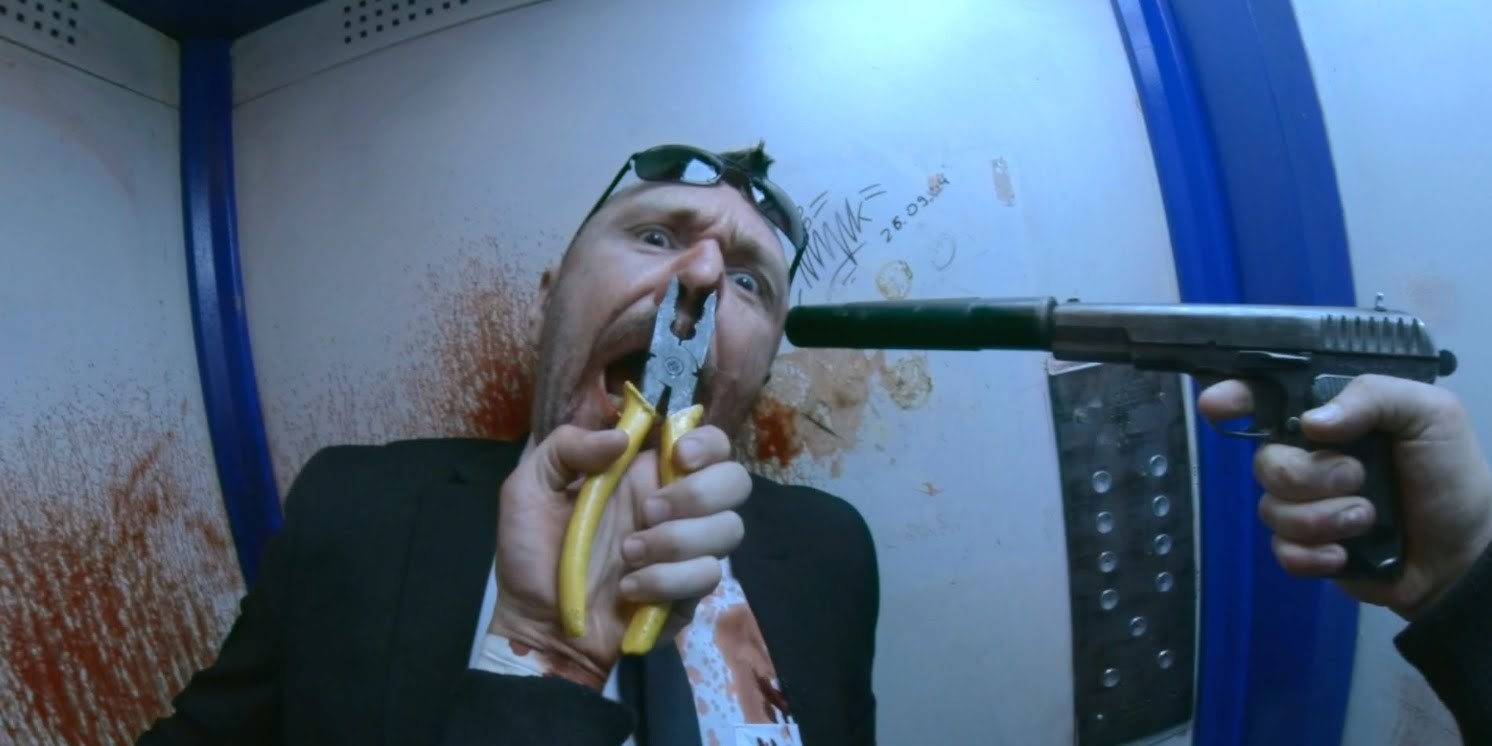
Hardcore Henry is visceral, loose, and spontaneous - everything I wanted Deadpool to be. No off-screen headshots here: the blood splatters everywhere (often with chunks of brain), even onto the screen. Through Henry's eyes, we slice, shoot, crash, tear, and blow holes into everything, in ways that'll make Mortal Kombat fanatics drop their jaws.

While the movie isn’t about videogames, director Ilya Naishuller was inspired by first-person shooters, integrating some of that style in the film. The nods are everywhere, from Call of Duty and Gears of War, to Max Payne and Bioshock Infinite. A henchman will close a gate, and Henry, instead of opening it, will wall-jump over. Guns and ammo are littered about like cigarette butts. Henry jams two syringes of adrenaline in his thighs and goes berserk, like Mario touching a star.

Sharlto Copley is a comic tour-de-force. This is my favorite role of his, eclipsing District 9. Think if Jim Varney from Ernest Goes to Camp starred in Ichi the Killer. At times, Copley’s Jimmy is a mohawk-wearing punk, bouncing off the walls; a prim and proper WWII-era British officer; a coked-out party animal; and a guerrilla soldier camouflaged as a shrub (who happens to skulk around exclusively gray environments). Each disguise is funnier than the last, and Copley’s manic energy brings it to life.

All in all, it's a blast. My grin reached from ear to ear for most of the movie, and for a good hour after. If you're a gamer, if you're a fan of ballistic insanity, if you're a fan of ridiculous comedy, this hits all the right notes. This is the kind of movie that we should say "pushes the boundaries," because it pushes the genre forward. Hardcore Henry comes out on April 8th.

Thank you all for reading; I'm the Man Without a Plan, signing off.


Monday, March 14, 2016

"10 Cloverfield Lane" Review

10 Cloverfield Lane is the sequel/spinoff/unfortunately-titled-follow-up to 2008’s Cloverfield. Both were releases with minimal marketing, revealing next to no information as to what the movie’s about. And that’s where the comparison ends.


The Cloverfield series has gone the American Horror Story route and become a sci-fi anthology. Cloverfield is a found-footage monster movie; 10 Cloverfield Lane is a boiler-room thriller. 
I rarely say this, but there’s absolutely no need to watch the original to understand the sequel. However (and I do say this often), it’s not a very good film.

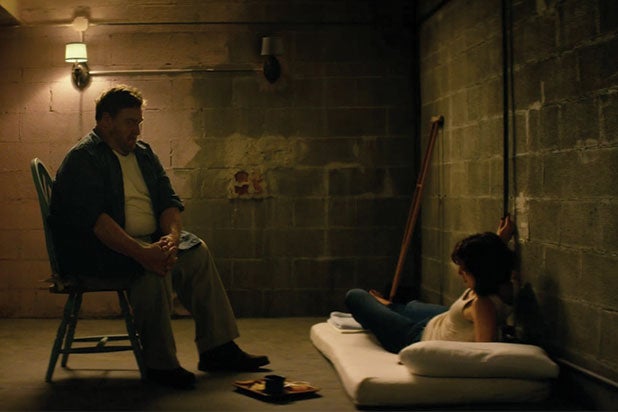
Michelle (Mary Elizabeth Winstead) leaves her jerk of a boyfriend in search of a new start. She’s driving on a country road at night when she’s blindsided by a truck, run off the road. She wakes up in The Blair Witch Project basement, her leg braced and chained to the wall. It’s there she meets Howard (John Goodman), a conspiracy theorist who saved her from the wreck and brought her to his underground bunker.

Howard tells Michelle there’s been an attack. Nuclear fallout has polluted the atmosphere and killed everyone – they, along with Howard’s friend Emmett (John Gallagher Jr.), are the only survivors.

Goodman is great here. He's unpredictable, jumping into a fit of rage just as quickly as he flashes a warm grin. We're never certain of what's a lie or just the ramblings of a maniac. He can be a host, a patriarchal figure; at times, he hints at desire for Michelle. Howard's a character whose masculinity is always threatened, and it takes only the slightest of "disobedience" to set him off. Goodman is volatile, and his physical presence helps keep Michelle (and us) on edge; if he wants to, he can probably do some damage with ease.
Winstead plays Michelle as a quick thinker, someone who's always piecing an escape plan in the back of her head. It's fun to see her makeshift solutions come to life. I'm reminded of Saw, situations like where Michelle needs to reach her phone while chained, and only has a smattering of items to use.

Claustrophobic thrillers run the risk of turning stale. They’re restrictive in nature, limiting the amount of characters, location, and action. When a thriller stays one step ahead of its audience, turning the screw on their expectations, it builds unrest. However, 10 Cloverfield Lane is predictable. Will two characters have an awkwardly-place heart-to-heart about how they run away from their problems? Check. Will a clue fall out of the random book Michelle decides to grab from the bookcase? Absolutely. Will the ominous music force itself on every scene, even when Michelle puts on pants? It wouldn’t be a PG-13 thriller without it.

I was bored, and even when the third act rolls around, the story wraps up so quickly it feels like an afterthought. Makes sense considering Bad Robot bought the script, originally titled The Cellar and later hired Damien Chazelle (writer/director of Whiplash) to make it fit the Cloverfield universe.

The movie sequel-baits, and at the end, I feel like I've seen the pilot to a TV show. Maybe that's where Cloverfield belongs. Perhaps a Netflix deal can be reached? Or maybe I could watch The Twilight Zone instead.

Thank you all for reading. I'm the Man Without a Plan, signing off.


Sunday, March 6, 2016

"Zootopia" Review

Forgive me Shrek, if I borrow your metaphor. Zootopia is like an onion: it has layers, and I think it’s important to talk about it in that sequence.

For those who have neither the time nor patience, however, here’s your headline. Zootopia is the best Pixar film that Pixar never made.

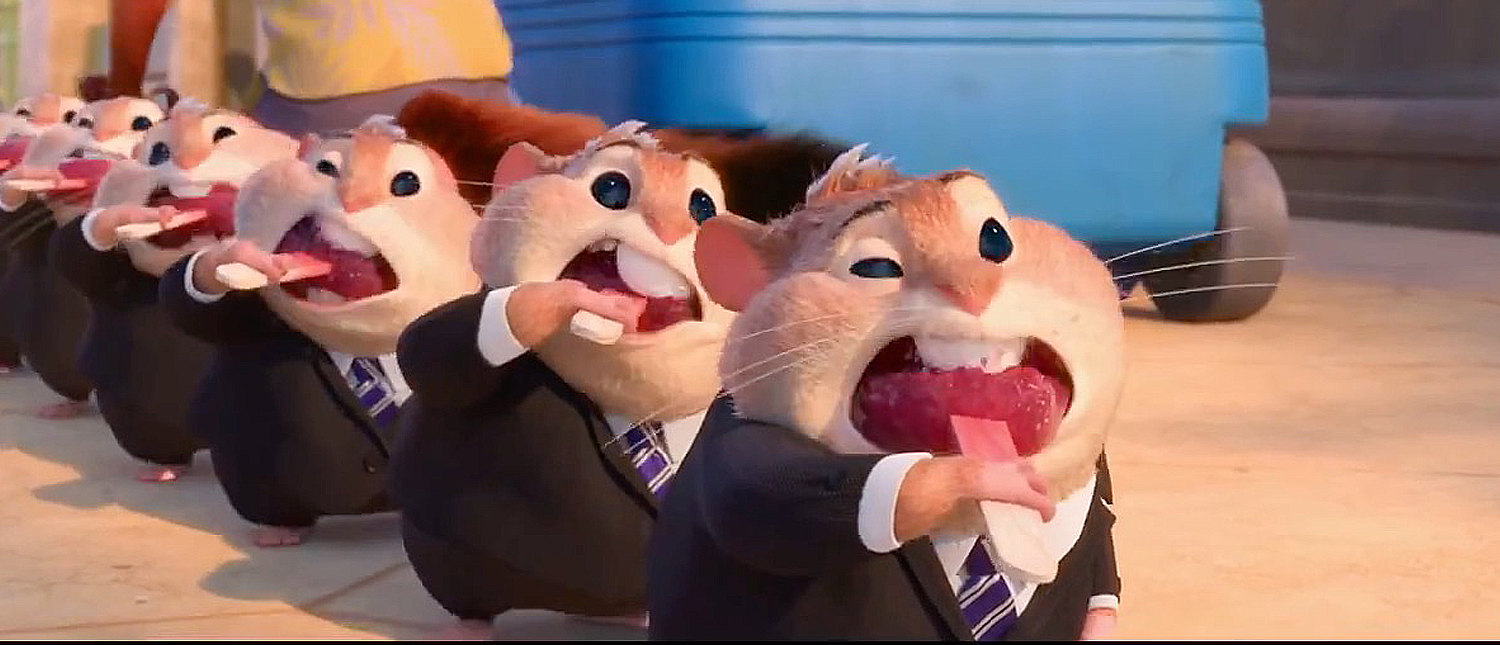
Zootopia is a city where a bevy of anthropomorphic animals, from the biggest giraffe to the smallest suit-wearing hamster, live. The city’s center is a concrete jungle, surrounded by districts of varied climate – Tundra Town, Sahara Square, Rainforest District. A neighborhood called “Little Rodentia” is about as literal as you think: everything is rodent-sized, from the buildings and cars to the pnuematic tubes hamsters and gerbils use to get from office to home. Advertisements for “Hoof Locker”, “Catsio”, and “Targoat” are everywhere, and it’ll take you a couple viewings to catch them all. (To be honest, I’m sure I’m still missing some.)

In Zootopia, predator and prey live in harmony, the product of generations of evolution. As explained to us by rabbit Judy Hopps (Ginnifer Goodwin) in her school play, the city is built on the idea that “anyone can be anything.” A sheep can become an astronaut; a leopard can become an actuary; a rabbit named Judy can become a police officer…the first rabbit police officer.

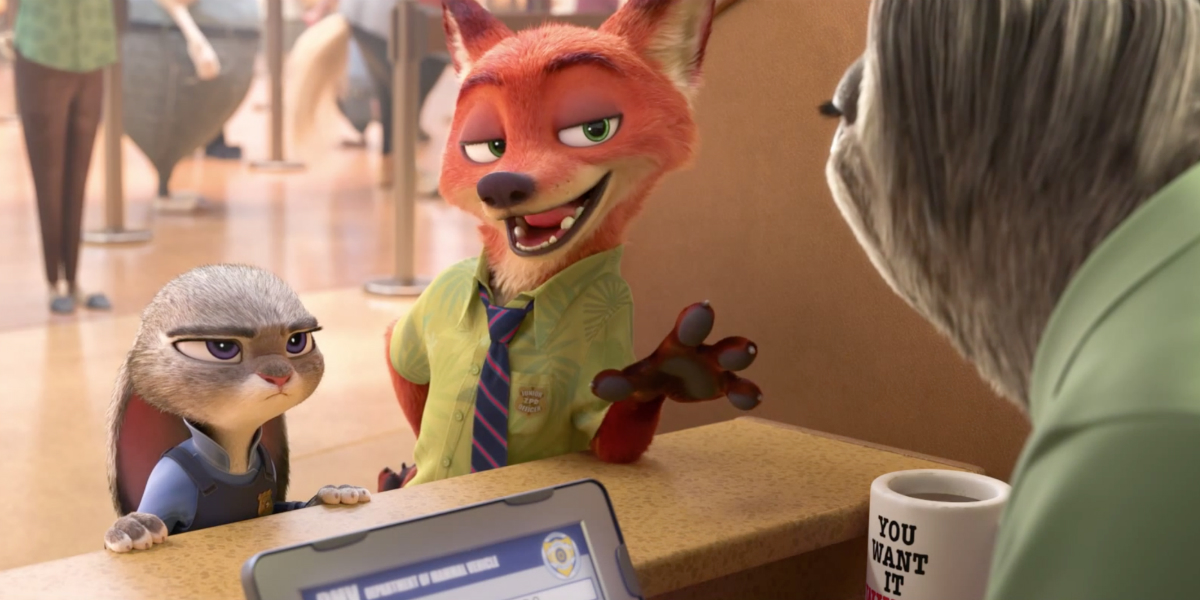
Fifteen years later, Judy has graduated, top of her class, from the police academy, and through the Mayor’s “Animal Inclusion Initiative”, is assigned to Precinct 1, in the city’s center. She’s relegated to parking duty, but when an otter goes missing, she teams up with Nick Wilde (Jason Bateman), a con-artist fox, to crack the case.
The missing persons (so to speak) plot is a smart thrill, involving Judy and Nick in a cross-district caper where they come across a series of colorful characters, including a sloth who works at the DMV (of course), a hippie yak who oversees a “nudist” colony, and my favorite, a mafioso, Brando-lookalike shrew named Mr. Big (played by Maurice LaMarche of Pinky and the Brain fame). In classic noir fashion, the plot provides enough twists and turns to keep an audience guessing, developing them well to where they don’t feel cheap. Clues are sprinkled in the background, so keep your eyes peeled.


Judy and Nick are destined to become a classic Disney pair, like Timon and Pumbaa, Tod and Copper, Marlin and Dory. Watching by-the-book, naive Judy getting punked by sly Nick is hilarious (his smug grin is half the fun). Judy wises up quick, though, making for a good back-and-forth. Goodwin and Bateman have infectious chemistry; they balance each other so well that any other actors in the roles would be an overall detriment to the film.

Peel back the layers of talking animals and noir, and in Zootopia resides one of the most comprehensive, enlightened critiques of race relations and prejudice I've ever seen. From the small-scale (upon their first meeting, Judy praises Nick on how articulate he speaks, to which Nick sarcastically retorts he's never been so patronized before) to the large-scale (predators are often placed in positions of power, discriminating against prey, despite making up only 10 percent of the population), the movie explores multiple levels of racism.

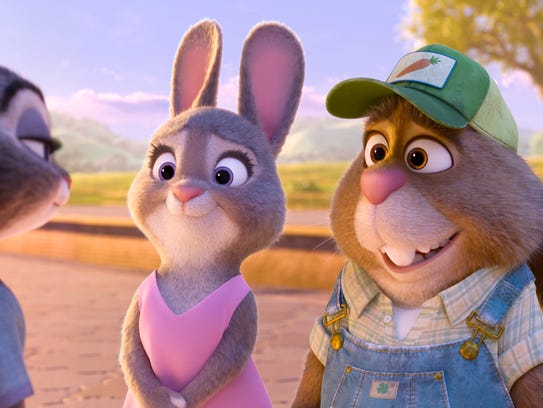
And it's not just predators oppressing prey. Everyone involved is guilty of stereotyping. Judy's parents try to equip her with a myriad of anti-fox protection before she leaves for the city, including repellent, pepper spray, and a taser (which sounds like a laser rifle, dear god). The media plays a role; they perpetuate the stereotype of the "savage predator," tying crime stories to the narrative, to the point where a rabbit mother, upon seeing a tiger sit next to her on the tram, moves her young son closer.
Zootopia doesn't outline a solution in institutional terms (because nothing gets a kid more excited than the sound of "systemic racism"), but boils it down to a simple component: the individual. You can call for all the affirmative action and PC watchdogs in the world, but you can't force a change of opinion. The individual has to be receptive. We learn prejudice from our environment, and it's going to take effort to push back against them. When we think about racism, the first thought stems from our upbringing. What matters are the second and third thoughts, because they show how we truly feel and shape how we act. 

To change the world for the better, Zootopia urges us to simply try. If you get enough people (or animals) to try, you'll start to see a shift. That goes beyond talking animals and buddy cops, and cements Zootopia as not only one of Disney's best, but an essential film in its own right.

Thank you all for reading. I'm the Man Without a Plan, signing off.


Sunday, February 28, 2016

The Oscar "Best Picture" Showcase - 2016

Welcome to the Man Without a Plan's "Best Picture" showcase for the 88th Academy Awards! Like last year, I'll be ranking the nominees based on preference, as well as giving some insight as to what films I think have the best chance of taking home the gold tonight. Before the ceremony, let's brush up on some of the year's best.


8) Bridge of Spies

If there's a nominee most people have a problem with, it's Bridge of Spies, because in their minds, even an average-quality Steven Spielberg/Tom Hanks collaboration will get Oscar voters itching in their seats.

Surely, Spielberg and Hanks have nothing to lose. The pair have accumulated five Oscars and the acclaim of both critics and movie-lovers. Hanks is only second to James Stewart as American cinema's best everyman, and Spielberg is synonymous with the word 'director', with a fantastic instinct for moments and visuals that will capture an audience's attention and passion. There's no real stress for both of them; the Coen brothers helm a screenplay that lets the story be more laid-back than Spielberg's usual fare. The important question, then, for Bridge of Spies, is not "How?" nor "What?" but rather, "Why?"

In a political climate that fears the influence of Islam, among a population that believes terrorism is an ethnicity, I find a film like this important, the same way people saw Selma as important during the outbreak of riots against police brutality. America has always struggled with its idealism in the face of practical desires and gains (slavery, manifest destiny, the Monroe Doctrine, democracy vs. republicanism), and where the government is practical, James Donovan (Hanks) opposes, promoting the spirit of what America hopes to be: a democracy whose laws and bureaucracy follow a morally righteous code.

The Russians may torture our spies, but in Donovan's eyes, a moral victory (where we show their spies respect, and give them a fair trial), will ultimately result in an influential victory. When there's no war on the battlefield, the war is waged with minds and influence. In the same vein, I think it's important to step back from a bipolar view of foreign politics and make sure that we're fighting a corrupt ideal and its practitioners, not their neighbors with the same skin color.


7) Brooklyn

Screen Junkies, in their Honest Trailer, called this the nominee no one saw, which is both true and a terrible shame. Behind the award bait of a 50's period piece lies an extraordinary lead performance by Saoirse (pronounced Sur-shuh,  you're welcome) Ronan, a breakout turn by Emory Cohen, a tender Nick Hornby screenplay, and simple, yet poignant direction by John Crowley.

The period elements are gorgeous, and it's always a delight to, in a way, time-travel to a long-gone era. I'm a sucker for an emerald bikini and a greaser haircut, is what I'm getting at.

American movies about immigrants often use their characters to highlight the scourge of urban decay, our country's superiority, or the ignorance of another culture.

Brooklyn keeps the focus where it belongs, on Ronan's Ellis: her dinners at the boarding house, the budding romance with Tony (Cohen), her strained relationship with family. She's not an innocent nor weak-willed. She's intelligent, funny, and determined, but the movie's not afraid to show her bitterness.

It's in the details where we see Ellis come of age and into her own, in her poise, the waning accent, her willingness to not only open up, but enjoy it. I think, as a viewer, when you open up to her story, you'll enjoy it too.


6) Spotlight

Spotlight explores the loss of innocence, not just in its subject matter, but also in its structure. When the Boston Globe's Spotlight team finds out the amount of pedophile priests in the city are more in the ballpark of 90 than 13, we're blindsided along with them. At that point, we and the reporters don't know who to trust, and where the rabbit hole of cover-ups and sin ends.

Mark Ruffalo and Rachel McAdams' characters talk about how the investigation makes it difficult to go to church, talk about it with their families. They struggle with the ideals of religion given what their leaders are doing behind closed doors, even questioning if those teachings retain their worth. If even rapists can pray and receive forgiveness, is this a god we wish to follow? I know these two things are separate, but corruption can lead to crises of faith like this.

It's important that these reporters are from Boston. They're just as entrenched into the community, into Catholicism, as everyone else. Marty Baron (Liev Schreiber) notes that sometimes, an outsider is needed to uproot and expose the evils of a neighborhood, and in doing so, brings up a parallel for what journalism should do. It should be a private entity, separate from corporate, political, or communal influence, and serve as an objective (as much as possible) observer and watchdog.

The movie, just like the real investigation, does its research, and brings up what a scandal like this can say about journalism, religion, and sociology. It's thought-provoking material like Spotlight that catalyzes action and a change of mind. It's won the Critics' Choice Award and AFI award for Best Picture, so there's a good chance for it taking the prize at the Oscars.


5) Mad Max: Fury Road

They don't make 'em like they used to.

As someone who just finished watching the Mad Max series for the first time thirty minutes ago, I have this to say: it's a punk rocker's Lawrence of Arabia.

Director George Miller marries the spirit of the '50s and '60s epics with a modern-day look, and in doing so, crafts one of the best action films of the past twenty years. We're thrust into Max (Tom Hardy) and Furiosa's (a badass-to-the-bone Charlize Theron) world. Cars flip; sparks and bullets whiz by the camera; a pale War Boy with a sharp-toothed grin plays a double-necked, flame-spitting guitar; and when Nux (Nicholas Hoult) screams "Witness!" I find it impossible not to scream it back. The movie starts and I think it takes literally 25 minutes to get any hint of silence.

Miller has never been afraid to push what his audience can handle, and it's tough to witness some of the death that occurs here. But that's the point: death matters. Amidst the technicolor balls of fire and spike-laden dune buggies, we know who dies. We know who they are, what they stand for, and what the ultimately give their lives to defend or pursue.

Fury Road is what should happen when a filmmaker's inner 13-year-old writes a story: a tale of sound and fury, signifying revolution.


4) The Big Short

This was the scariest movie of the year.

After watching the breakdown of how the 2008 recession occurred, the level of greed in Wall Street and the government that facilitated this economic meltdown terrified me (there's some blame to place on homeowners who got into mortgages they couldn't afford, but the film doesn't really address this). It made me talk to my accountant father, on how to be prepared for something crazy happening in the future.

Also, the film's hilarious (Insert the Starburst narrator here).

Adam McKay directs the film half like an Office-style mockumentary and half like a heist film, if the heist were legal. We know that people who scoff at these bankers are oblivious, and we're ready to see the whole thing blow up in their faces. They're absolutely clueless, and to watch Michael Baum (Steve Carell) about to blow a gasket in a casino, or watch Michael Burry (Christian Bale) slyly retort to an infuriated idiot of a hedge fund manager is pure glory. Also, I'm pretty sure I want "I'm jacked to the tits!" to be my new text message tone.

We think we're ready for the bomb to drop, like John Magaro and Finn Wittrock's characters are, but the film sobers up hard, never forgetting that despite all the numbers, at the end of the day, we're talking about jobs, pensions, savings; we're talking about people. The Big Short has been compared to All the Presidents' Men, and I wouldn't be surprised if history places it in that category. With a Best Picture win from the Producers' Guild of America (who have predicted eight out of the past ten Best Picture winners), I wouldn't be surprised if the Academy swings the same way.


3) The Martian.

This is the nominee I could watch every day, and it's two hours and twenty-one minutes long. You know what's even weirder? I think most people would agree.

I attribute this to a combination of Drew Goddard's screenplay, Pietro Scalia's editing, and Ridley Scott's direction. The movie never drags - the time on Earth is just as, if not sometimes more, intriguing than that on Mars. My favorite scenes feature the team at NASA hashing out a plan, whether it be to revive an old probe or to figure out how Mark Watney's (Matt Damon) going to fly out of Mars' orbit.

The important thing isn't what's going to happen, but how. The Martian resembles Gravity and Interstellar from years prior, but what separates it, and ultimately makes it better, is the attitude. There's no time to float aimlessly or spend seven years in an hour; there's work to do, a problem to solve. And if you solve enough problems, you get to come home... probably with a hatred of potatoes.


2) The Revenant

It's likely you'll see this pop up again in January, when I talk about 2016's best, so I'll be brief.

Why is DiCaprio getting so much shit?

I've heard his performance criticized as just a series of grunts; belittled for its sparse dialogue; deemed the product of a Method actor trying too hard - "effort over performance," as one writer put it.

In this film, DiCaprio relies not on charm nor returns to the safety of a character who's a socially maladjusted elite. The Wolf of Wall Street and Django Unchained fit into the latter category, performances people point to as more worthy of the win. Did anyone complain about the grunts and crawls in the Quaalude scene, or the Method practice of staying in character as DiCaprio broke open his hand on a glass?

I think the backlash is just an Oscar tradition, a way for people to be contrarians and demand different from Hollywood when they really want a formula. The role of Hugh Glass demands physicality, needs silence. Would multiple monologues make sense for a man whose throat is slashed? Would that man be in a position to show off swagger?

The Revenant achieves spiritual enlightenment through physical pain. DiCaprio, through twenty years of experience, has achieved a body of work that rivals actors twice his age. Let the man have his damn Oscar.

(Will it win? With the most nominations of all the nominees, it's the frontrunner; the smart money is to bet on Revenant for Best Picture.)


1) Room

Room is in my top five of all time. This is as much a shock for me as it may be for you, but there is so much purity, strength, and love in this piece, I won't deny it.

Brie Larson is all but certain to win Best Actress. There was never a doubt for a second that she wasn't Joy Newsome, and that she didn't live solely for Jack (Jacob Tremblay) to have a better life. In a scene where Joy is interviewed, Larson delivers just the right doses of sorrow, anger, and poise, running a gamut of emotion fluidly in a span of two minutes.

I can't forget Tremblay, who adds just the right ticks to make this work - jumping when the phone rings, the indignation in calling his mother a liar, the slow gradient of opening up to people. With such a masterful performance at the ripe age of 9, there's a wealth of excitement in my mind on where his career could go.

Emma Donoghue's screenplay is extraordinary, developed with the patience and detail an award-winner should require. It navigates through the complexities of the situation without dumbing it down or reducing its characters to stereotypes.

It's that rare film that has it all: suspense, wonder, and the most palpable, heart-warming love. With every screening, it gives me a honest appreciation for life and all it has to offer. It probably won't win the Oscar, but it's completely won me over.

Thank you all for reading, I'm the Man Without a Plan, signing off.
Thursday, February 18, 2016

"Deadpool" Review

My girlfriend asked me to save seeing Deadpool for Valentine's Day, so from Thursday to Sunday night, I was bombarded with comments from giddy fans and coworkers who wanted to know what I thought.

Well, in yet another edition of Unpopular Opinions to Popular Movies, I didn't like it.

Ryan Reynolds stars as Wade Wilson, an ex-Special Forces operative and mercenary. When he develops terminal cancer in his "liver, lungs, prostate, and brain," he travels to a top-secret experimental treatment center. Surprise, surprise - the treatment is a front for an illegal genetics-altering facility, led by the sadistic Ajax (Ed Skrein). Ajax injects Wade with a serum that will unlock his mutant powers if exposed to enough stress. Wade is tortured mercilessly, but becomes a mutant. He develops near-limitless regeneration, but at the cost of physical deformity throughout his entire body. Seeking revenge, Wade puts on the costume and mask, and adopts the moniker "Deadpool", hunting down anyone who can get him closer to Ajax.

Those who know the Marvel Comics character know there are four essential qualities he must have: he holds allegiance to no one; uses the 4th wall as a jump rope; can't take three steps without taking a shot or swipe at someone; but most importantly, his absurdity is hilarious.

Reynolds gives it his all, snapping goofy banter and filling the screen with the widest mischievous grins possible. However, the writing fails him. It's laden with too many metaphors that read like nonsensical Mad Libs. Using words like "dicktits" and "shitbuckets" mistake raunchy for absurdity.

Much of the first half is ripped from the trailer. Even worse, the trailer features the best jokes, which to their credit, are wonderfully wacky, but when hearing them for the second time, doesn't give as strong of an impact.

It also seems strange that a Deadpool movie would have such a generic plot. Deadpool fights waves of henchmen to get to the second-in-command, beat them, fight the big British baddie to try and save his girlfriend. The story tries to break up the formula by bouncing between the highway scenes from the trailer and flashbacks, but this backfires. Every time the movie returns to the highway, the story progresses just a little before taking three steps back to the flashback.

And this is Deadpool. For a hero like Blade, Thor, or Captain America, I would expect this, but for a character whose existence serves to subvert and surprise, a typical origin story seems like a neutering move.

Keep in mind, Deadpool has done the following in the comics:


- Romanced the literal personification of Death 
- Assembled the Deadpool Corps, made up of Deadpools from alternate universes, including Lady Deadpool, Dogpool, and the severed head of Zombie Deadpool
- cooked 372,844 pancakes for breakfast
- shot someone in the head for saying they enjoyed the Star Wars prequels more than the originals
- teamed up with the ghost of Benjamin Franklin to destroy a group of resurrected zombie presidents
- successfully incapacitated Carnage with a super-powered mp3 player full of dubstep
- switched costumes with Spider-Man to fight (and kill) the Chameleon

There are glimmers of brilliance. I love the production design, where each and every corner of the frame is covered in Easter eggs, memorabilia, and goodies for fans to catch and revel in the geek culture. (When Negasonic Teenage Warhead took off her jacket, I nearly whooped.)

The best parts of the movie feature Reynolds out of the suit, romancing it up with his girlfriend, Vanessa (Morena Baccarin). They have extraordinary chemistry, the kind of couple where one will crack a dark joke and the other will run with it as far as possible. While her character, in the grand scheme isn't given much, Baccarin gives her genuine, hysterical charm. In this aspect, Deadpool works really damn well as a Valentine's Day movie. I caught myself often leaning over to my girlfriend and whispering, "That's us."


For people whose experience with comic-book movies starts with X-Men and ends with Ant-Man, they'll find something new in the violence, the level of comedy, and the unique tone for a superhero film. After Deadpool, I'd recommend checking out films like Watchmen, Hellboy, Kick-Ass, 300, Sin City, and Scott Pilgrim vs the World, if one's interested in getting away from the safeness of Marvel and DC.

I think this is the most secure bet a studio could provide for a character like Deadpool. Recently, we're getting more obscure characters - look at Guardians and Ant-Man - but the stories borrow from one another - Avengers and Iron Man, respectively, and it's getting to a tipping point of boredom.

I honestly think audiences are ready to get strange. With Doctor Strange coming in November and Avengers: Infinity War - Part I coming in 2018, I hope Marvel and their properties, across multiple studios, take the kind of risks that characterized them eight years ago, with the creation of the cinematic universes.

Let's throw in some magic, some aliens, some inter-dimensional hopscotch.

Let's get weird.

Thank you all for reading; I'm the Man Without a Plan, signing off.


Friday, February 5, 2016

"Pride and Prejudice and Zombies" Review

I feel the marketing team for this film should have placed an ellipsis in the title: "Pride and Prejudice...and Zombies", because the zombies might as well be an afterthought. If last October's Scouts' Guide to the Zombie Apocalypse proved the zombie trend was dead to its audience, Pride and Prejudice and Zombies proves it's dead to Hollywood. What it leaves on the table is a shoddy adaptation of Jane Austen's novel, with the kind of violence and cleavage that executives calculate will bring in the teenage boy demographic.


Austen's novel, about romance and opposition to rigid Victorian English custom, remains similar, with a few notable differences. London has been overrun with a virus that creates zombies, so as a result, the aristocracy holes up in the center of the city. They build a hundred-foot-wall around the perimeter, a moat whose size rivals the Panama Canal, and cut off all entrances in and out of the safe zone except for one bridge, guarded by every soldier possible.

The Bennet daughters are now warriors, trained by their father (Charles Dance) to defend themselves from the undead. Their mother (Sally Phillips) still holds fast to tradition, pushing her daughters to attract wealthy, marriage-worthy suitors. Elizabeth (Lily James) is the most opposed, feeling society's expectations of femininity threatens her individuality. Her other sisters, including Jane (Bella Heathcote), are more accepting, and when they're invited to a dance, Jane starts a courtship with a charming noble, Mr. Bingley (Douglas Booth). 

Bingley is accompanied by his friend, Colonel D'Arcy (Sam Riley), a stern, arrogant man who's focused more on anti-zombie measures than a woman's curves in a corset. In his first talks with Elizabeth, the two butt heads, and start to hate each other, but as a conspiracy threatens to unite a zombie army and bring about the apocalypse, the duo may have to work together to save their way of life, and possibly fall in love in the process.
Burr Steers directs a clumsy script (which he also writes), ill-paced and unsure of how to balance romance and horror. The answer, I suppose, is to weigh the movie down with subplots, including one featuring a eyepatch-wearing lady (Lena Headey) who wants her daughter (given no dialogue or even a name) to marry D'Arcy, and one where a foppish parson (Matt Smith), COUSIN of the Bennetts, arrives at town to desperately try to wed and bed one of them. Charming.

If the movie were at least outlandish, I'd be more inclined to treat it as a glorified B-movie, in the vein of Hansel and Gretel: Witch Hunters. However, the film spends many scenes indoors, with proper English folk either detailing exposition, or partaking in the "woman as trophy or titan?" argument. Both are handled lazily, serving to pad out the movie to 107 minutes.

The zombies are given the CGI treatment, to where they look like the products of a Snapchat filter. We do see the usual rogues gallery: the horde, the top-half crawlers, and the Two-Face (human on the left, zombie on the right). They're zombies, and for the most part, the movie keeps it simple. However, in the later half, a development arises in a church scene that takes the mythology and spits in its face. If you were mad at what Twilight did to vampires, you ain't seen nothing yet.

This is a classic case of a film that dawdles around like a teen procrastinating their essay until the last minute, where they cram loads of information in little time. The movie tries to tease forthcoming elements until the end, but it's handled awkwardly and abruptly, to the point of confusion; I wondered if I had blinked and missed something. When the third act rolls around, it's sloppy and anti-climactic. The fights are forgettable, reminding me of better videos on YouTube (Freddie Wong's work comes to mind); the acting is lifeless; the mid-credits scene feels hacked off from the ending.

Instead of Pride and Prejudice and Zombies, watch a double feature of Pride and Prejudice (the 2005 version with Keira Knightley) and Return of the Living Dead. You'll satisfy both cravings and stay awake.

Thank you all for reading, I'm the Man Without a Plan, signing off.