Sunday, May 10, 2015

"Avengers: Age of Ultron" Review: Episode II - The Divide

My second viewing of Avengers: Age of Ultron took place last Sunday. After the tumultuous Thursday (described in detail in Episode I), I needed to toss out the remnants of bad experience, and go in with as much of a fresh mind as I could muster. In my case, that's best achieved with a Coke in hand and family/friends next to me. No 3D probably helped.

After recovering Loki's scepter from the HYDRA research base in Sokovia, the Avengers - Iron Man (Robert Downey Jr.), Captain America (Chris Evans), Hulk (Mark Ruffalo), Thor (Chris Hemsworth), Black Widow (Scarlett Johannson), and Hawkeye (Jeremy Renner) return to their New York headquarters to celebrate. Tony Stark and Bruce Banner determine they can fuse the scepter's power with Stark's security program, Jarvis, to create a global peacekeeping project called Ultron, an AI that could mobilize and command Stark's army of robotic suits in the event of another alien attack. When Ultron (James Spader) is activated, he decides (in typical sci-fi fashion) that humanity is the problem and needs to be eliminated; it's now up to the Avengers to take Ultron down and save the world.

My feelings here are complicated, in the same way after I saw Iron Man 3. I felt the hype, rushed to the theater opening weekend (in a top hat and suit, I might add), and enjoyed the experience; but on the drive home, I found myself addressing inconsistencies and flaws. Once the hype died down, I could step back and realize that the movie didn't work as well. But while I utterly dislike Iron Man 3, Age of Ultron is fun!

There are gems here, some which are executed even better than in the original. We get to explore characterization for lesser-focused characters, such as Black Widow and Hawkeye. Hawkeye actually becomes the runaway performance here; from a stoic crony-turned-friend in the last film, the character's come into his own, as a sarcastic every-man who, with talk of aliens, gauntlets, and robots, is in over his head, but dutifully continues to fight for the greater good, no matter the odds. Renner gives the character showmanship, but balances this with an earnest folksiness that's endearing.


Look at this gif. Let it sink into your mind. The child in me roared with joy. I've been waiting to see Iron Man's Hulkbuster for years, and the bout (as opposed to last Saturday) didn't disappoint. The stakes are high, with each hero dishing as many hits as he takes. Infrastructure is crushed, buildings are wrecked, and Tony's one-liners, juxtaposed against such visceral imagery work their magic here. There's a playfulness to this fight and the action in general that elevates it past the usual apocalypse porn. The fight is a consequence of the story, rather than bloodlust.

Speaking of bloodlust, let's talk about Man of Steel. One of that film's greater faults was the wanton destruction of Metropolis, where Superman's defense ended up in obliteration and the death of millions. I'm sad to call it refreshing whenever Age of Ultron places an importance not only on defeating Ultron, but the manner in which the Avengers do it. Captain America makes it clear: the Avengers defend and protect. He refuses to accept any civilian casualty, and as the leader, holds the rest of the group to this higher standard. This isn't always the most tactical decision, sure; but if heroes are to portray humanity's courage and nobility, should we not expect anything less?

So where does Age of Ultron falter? Sloppy writing. Plot points are brought up, but never fully explained; characterizations are either underwritten (Black Widow), grossly ill-developed (Tony Stark), or confusing in tone (Ultron); information is stuffed in to further the universe's overarching story, regardless of whether it's paced well. Throughout the movie, I get an overwhelmed feeling, as if writer/director Joss Whedon was butting heads with Marvel Studios producer Kevin Feige as to what needs to be placed in the movie and how much time each element should receive.

The first Avengers was the payoff to a sprawling cinematic project. In the years preceding Iron Man, where the third installments of the X-Men and Spider-Man series were criticized as bloated messes, the idea of a cinematic universe that could tie together a plethora of characters from different films was insane, impossible to pull off with different writers, directors, and studio executives all influencing the creative process. However, as the MCU grew, offering nuggets of information through post-credits scenes and many Phil Coulson/Nick Fury cameos, the idea became less and less far-fetched until finally, at the end of Captain America, we got a teaser trailer for the first Avengers. 

The rest is history: the movie became, domestically, the third highest-grossing movie of all time (not adjusting for inflation), lauded by critics and audiences, and the only film at the time that seemingly could contend with The Dark Knight for best comic book movie (I personally put my money on Avengers, but that discussion can take place on another post). The biggest risks earn the biggest rewards, so it only makes sense that Marvel Studios' experiment paid off, and paid off handsomely.
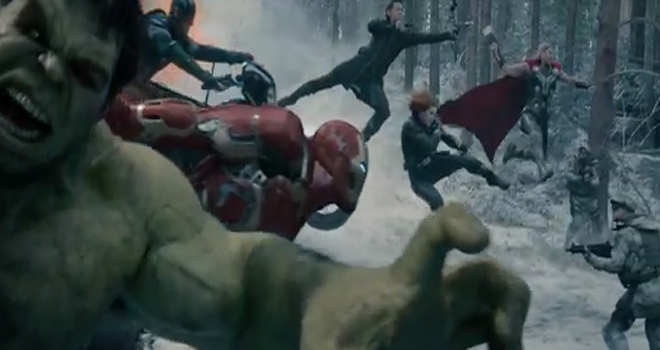

So what does this history mean for Age of Ultron? Simply put, the hype is its Achilles heel. People were expecting lightning to strike twice, but Avengers and Age of Ultron serve two different purposes. Where the first film proved the MCU was functional, the sequel acts as a bridge, trying to tie up loose ends of the MCU's second phase and tease Phase 3 elements (the likes of which include Black Panther, Captain America 3, and of course, Avengers: Infinity War - Part 1 and 2. Does this leave Age of Ultron a less focused, less satisfying movie than Avengers? Yes. However, does it fail to entertain? Hardly. I'd say go see it, but you probably already have.

Thank you all for reading; I'm the Man Without a Plan, signing off.


Wednesday, May 6, 2015

"Avengers: Age of Ultron" Review: Episode 1 - Story Time (Or the Anticipated Cluster of Nonsense)

(Why "Episode 1"? Because I've got a bit of context to add to the review that ended up being a few bits more than expected. If you want to read the normal review, check out Episode 2, which will be up later. - The Man Without A Plan)
-------------------------------------------------------------------------------------------------------------------------------------------------------

Last Thursday, I found myself racing down the highway to deliver a late term paper to my professor. I knew I was losing ten points each day it wasn't in his hand, and that in order to finish the essay and deliver it, I had to skip half of the Avengers double-feature at the theater (a $25 investment). It was more than likely, a sliver away from certain, that I wasn't going to make it in time for Age of Ultron, but I couldn't justify losing 20 points on a paper because of a movie...even if it was one of the year's biggest blockbusters.

I hauled ass in five o'clock traffic, which eventually turned to six and six-thirty (the movie was at seven). As I sprinted from the frat houses' back parking lot to Wooten Hall two streets away, I estimated that if I broke warp speed in my car, I'd still get to the movie a half hour late. With paper in tow (almost crashing head-first into the door), I burst in the building only to find my professor's office and the department mail room locked. I paced around aimlessly for a minute before the dash to Wooten devolved into a dejected walk back to the lot. I'm still not sure the expletive I roared in the car wasn't overheard by the guys smoking nearby.

The tires screeched into a Nordstrom parking space at 7:30; my feet glided up the winding staircase; I nearly flew, Michael Jordan-style, over the crowd control barriers; and as soon as I landed in front of the box office, my headache finally caught up, like a baseball bat to the temple.

The next ten minutes can be described as follows -

INT. AMC THEATERS - LATE AFTERNOON

DANIEL waits for the LADY at the box office to print out his ticket for the Avengers double-feature, which he's two-and-a-half hours late to.

LADY 
You know this show started at 4:30 right?

DANIEL
(laughing bitterly) 
Yes. Believe me, I know.

LADY
What? Why isn't this working? Kelly, can you come over here?

KELLY, a short brunette cosplaying Black Widow, turns around, approaching the lady's console.

KELLY
Did you try the thing?

LADY
Yeah, it's not confirming.

Kelly awkwardly glances up at Daniel who grins back sympathetically. 

KELLY
Do the other thing; I've got to handle these guys.

LADY
I'm sorry sir; come around to the back, we'll get it settled.

INT. AMC THEATERS - BACK OF BOX OFFICE - CONT.

Kelly oversees a YOUNG MAN facing the console with a blank, confused stare as three TEENS wait with goofy impatience.

The lady motions to a MANAGER to come forward. She walks up to the lady behind the counter.

MANAGER
What's going on?

LADY
He bought a ticket online; the system won't confirm it.

MANAGER
I'm sorry, sir. We should have this up in a minute.

Daniel gives her a half-smile. One of the teens digs his pointer finger in his nostril, possibly in a search for a golden nugget of decency.

The manager, annoyed, comes out from behind the box office. She approaches Daniel.

MANAGER
Sorry for the wait. I'm just going to escort you to the theater; you should be good.

DANIEL
Thanks, that's fine.

They walk past the ticket-checker and concessions stand.

DANIEL
I can imagine the day's been hectic.

MANAGER (chuckling)
And it's only gonna get worse. Now, it's slowed down, but later? Phew.

She stands to the side of the theater door, motioning to the sign - "16: Avengers Double-Feature".

DANIEL
Thanks for your help.

MANAGER
No problem, enjoy your movie.

INT. AVENGERS SCREENING - CONTINUOUS

Daniel walks into the theater, looks up towards the screen, and in a moment of realization, frowns.

DANIEL
Damn. The 3D glasses.

After going back to grab the glasses and positioning myself in the far left seat on the second row, I watched the movie. My neck craned towards the IMAX screen, head bursting into twenty pieces, and eyes struggling to keep up with the 3D projection made for a miserable experience, one of the worst I've ever had. 

The movie ended and it didn't wow me like I expected; I was reserving a spot on next year's Top Ten for this, and not only couldn't I reasonably do so, I felt animosity towards it. If I would've written a review the next day, "Avengers: Age of Ultron" would've received two-and-a-half stars. But bad experiences and high expectations aren't the movie's fault, and if there's anything to be learned from this rant/story, it's this: we're fickle, often ready to lose our minds if a movie ONLY gets a 8 out of 10 on IMDB, tossing out the baby with the bathwater if a sequel isn't a masterwork of perfection. If I can be ready to rage against a film for something as trite as a late paper, I think I need to calm down a bit, and to the mob of angry critics and Twitter users, I recommend the same.

So with that out of the way, stay tuned. We're gonna be talking Avengers: Age Of Ultron. 

Thank you for reading (if you actually took the time for this, with all seriousness, I thank you); I'm the Man Without a Plan, signing off.

Sunday, April 26, 2015

"Ex-Machina" Review


Recently, Hollywood has brought artificial intelligence to the forefront: Transcendence, Big Hero 6, Her, and the upcoming Avengers: Age of Ultron. Even films such as Lucy or Rise of the Planet of the Apes, less focused on the robotic, explore humanity's reactions to alternate sources of high intelligence, reevaluating our place in nature's mental hierarchy. It'd be easy, given the current inundation, for Ex-Machina to fade into the crowd. Instead, Alex Garland's (writer of Sunshine, 28 Days Later) directorial debut succeeds by asking the right questions: can human behavior be explained through biochemistry; are our minds just evolutionary taskmasters controlling husks of flesh; does our intellect make us human...and if not, what does?

Caleb (Domnhall Gleeson) is one of Bluebook's many young programmers. The search engine giant accounts for 94% of global internet searches (Google, as of this month, is at 88%, according to StatCounter). Caleb wins a company-wide lottery to spend a week at CEO Nathan's (Oscar Isaac) mountain estate. Initially excited, he's overjoyed when Nathan gives Caleb the task of testing out his AI prototype, Ava (Alicia Vikander), to determine if she possesses true consciousness.

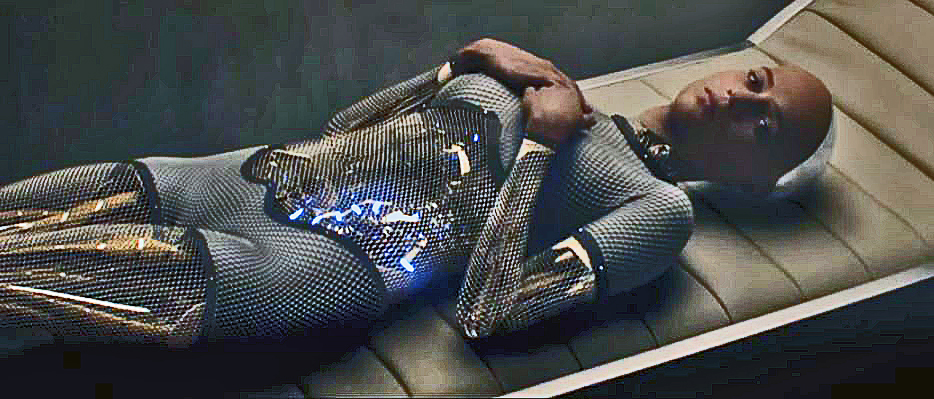
Ava has a woman's face, but her metallic exoskeleton reveals otherwise. However, she isn't off-putting, like something from I Robot. Yes, the circuitry below her neck gives her face an unusual plasticity, and her limbs are clearly metal, but Ava has a sensuality that's soothing. Her structure has curves; darker panels on her chest and below the waist resemble a sports bra and shorts. It's not difficult to look past the gears, so to speak. Vikander brings the package to life; her performance transcends dialogue, presenting a wealth of naivete, curiosity, and frustration often in the span of a glance.

Resembling Pinocchio more than the HAL-9000, she is less a god and more a child, attempting to deduce sensation from its dictionary entry. Nathan asks Caleb if he thinks Ava simulates the behavior of liking him, or actually does. With Caleb's puzzled pause, the film suggests this is the final hurdle, the determining factor for artificial intelligence: the ability to identify when a being can tie the abstract to the concrete, the word to the concept. Hardly a revolutionary revelation, but one left to be conclusively resolved, one that needs to be at the forefront of the conversation.

The scientific inquiry is cradled by striking production design, marvelous cinematography. From the labrinyth of hallways and mirrors in Nathan's home (or research facility, as he refers to it) to the snow-covered mountains and lush valleys accompanying them, Ex-Machina draws me into its claustrophobic, yet soothing atmosphere.

Some may find Ex-Machina underwhelming: it doesn't explain every mechanical detail or tell the same "man v. machine" story we've been used to. Instead, Ex-Machina focuses on us, and how the advent of artificial intelligence can serve as a tool to better understand ourselves, our psyche, our evolution as a species. With each viewing, I draw more from the film, whether it be from a painting in a room, or the placement of an actress in a shot. This is a film that won't let its audience ignore its questions; it starts a dialogue, like all good cerebral thrillers do. 

Thank you for reading; I'm the Man Without a Plan, signing off.


Sunday, April 19, 2015

"Unfriended" Review


Unfriended is the best remake of Paranormal Activity 4 we could have reasonably expected. 

The movie is a classic case of a decent idea gone wrong, an experiment whose execution leaves it a repackaged iteration of Feardotcom blended with the aforementioned Paranormal sequel (and not even #2). Crammed with stereotypes and desperately marketed (the trailer's preceded almost every video I've watched in the past two months), this is a lousy attempt by Universal to scrounge up whatever amount of money is available in the two weeks preceding Avengers: Age of Ultron.

After an embarrassing video is posted online, Laura Burns (Heather Sossaman) commits suicide, driven by the flood of comments telling her, "kill urself." On the anniversary of her death, a group of friends: Blaire, Mitch, Adam, Jess, Val, and Ken are chatting it up on Skype when someone going by Laura's username, "billie227", enters their conversation. Initially skeptical, the group tries to ignore it, but its supernatural presence plagues the teens, demanding they stay online or suffer death. 

The fear of being watched and obsession with watching others have been presented in films for decades, from Rear Window and Blue Velvet to Disturbia and last year's Nightcrawler.  In an age where we spend increasingly more time online every year, our identities aren't only exposed to our local communities, but the world; so for the "selfie" generation, a concept like Unfriended's makes sense. The movie all takes place on Blaire's (Shelley Hennig, Teen Wolf) laptop; we see her Skype interactions with the group, private messages on Facebook, search for info on Google. The digital setting offers opportunities for tension: a banner ad on a forum says "see who's following you;" "billie227" will answer Blaire's question before she sends it; menu options (often "delete") will suddenly disappear. Subtle moments like these help ramp up the weird.

However, for whatever tension and subtlety is there, Unfriended is 82 minutes of watching someone else on a computer screen. Throw in seemingly ceaseless scenes of teens screaming over each other about cheating, weed, and exes (when death is on the line), and the film grows near-insufferable. None of these characters leave an impact (except, ironically, Jess, for whom the number of pouts exceeds lines of dialogue; this makes me giggle), all stereotypical fodder for poorly-edited deaths. The latter half offers some chuckles; but by that point, I've already checked out.

What angers me, really, is the film's attempt to be some cautionary tale against cyber-bullying. Its characters are ripped straight from after-school specials, written so shallowly one can't relate to any of them. There's no emotional connection able to be made, so why would we care what happens to these people? When the film has an opportunity to hammer in the weight and damage such behavior can have, not only on the victim, but on the person responsible, it doesn't have the backbone to stand by its decision. Instead, it options for a cheap startle. Don't address this problem, one that has taken real lives, and dare treat it trivially. Show some respect for the dead.   

Unfriended is a cash grab. It fails at being a horror film. It fails in its morals. If you want a pulse-pounding, socially conscious thrill ride, go see It Follows; it's a better use of your time and money. Thank you all for reading; I'm the Man Without a Plan, signing off. 


Friday, April 17, 2015

"Illness" Review


Much of Raabia Ansari's Illness requires a basic understanding of Islam: its values and prohibitions. Those unaware of the significance behind the holy month of Ramadan and the concept of "nafs" may find themselves a bit confused. However, Illness keeps it simple where it counts, exploring faith's effect in one's day-to-day life in a manner relatable to most religious people.

Illness centers on a young man's (Adil Dadabhoy) hospital visit; he's lethargic, often with his head down, professing desperately to a nurse (Amy Mayo), "I can't control myself." Through a series of flashbacks, he reflects on prior events and how they've factored into his declining health.

Ansari directs subtly, giving scenes just enough information for an audience to comprehend the situation. With little dialogue, she relies on her actors and cinematography to get the job done. Dadabhoy wears melancholy convincingly (though a tendency to rub his eyes grows distracting after a while), and Mifrah Maqbool is understated, yet memorable as the doctor. Ansari's camerawork adequately tells the story, but blurs in and out of focus enough times to make me consider its artistic merit less than if the camera's working.

Regardless, Illness works. In the same manner as films like The Jazz Singer (though with considerably less blackface), Illness brings to light the difficulties faced by not only Muslim Americans, but members of all faiths, in balancing tradition and spiritual values with everyday culture. Never biting off more than she can chew, Ansari's firm direction drives the project forward, showing her clear understanding of how to bring a vision to the screen. Illness's success doesn't lie in its victory at this year's MSA Showdown in College Station, but rather in Ansari and her team's creation of a smart, focused socially-conscious drama.

Thank you all for reading; I'm the Man Without a Plan, signing off.


Thursday, April 9, 2015

"Let's Get Married" Review


Let's Get Married is a romantic comedy based on the popular 2013 Chinese TV show. Both movie and series examine the ups and downs of relationships, but unlike something like Sex and the City, the film centers on different characters than the show, choosing to follow it in spirit: glamorous and goofy.

The film navigates through four stories: Wenwen (Gao Yuanyuan) is the manager of a bridal boutique, dreaming of her own special day; Yi Wen (Bea Hayden Kao), a violinist, travels from Beijing to Italy for a competition, meeting Luca (Li Chen), a laid-back tour guide; Xiaoling (Zheng Kai) and Gu Xiaolei (Ivy Chen) are a pilot and stewardess debating whether it’s the right time to get married; Hotel manager Hai Xin (Liu Tao), feeling upstaged and ignored by her star chef husband Cao Depeng (Wang Zijian), begins to question her marriage after a nasty argument.

If four stories in two hours sounds like a jumble, it shouldn't; but somehow it is. The film's first half paces well, even if it tends to enjoy Wenwen and Yi Wen's stories more than the other two. However, by this time, I feel the stories are getting ready to wrap up. Imagine my shock when I check my phone and see I have an hour left.

This latter half slugs along, padding out stories for dramatic "tension;" but here's the rub: these stories are no Shakespeare. There's little surprise to be had, and the film treats the viewer as if they've never seen a romantic comedy. In essence, I'm waiting for the film to cross off moments from my mental checklist: the misunderstanding separating a couple, the realization a character has been an idiot to their significant other, the wedding scene, etc.

But just because I've seen films like this before doesn't nullify Let's Get Married's existence. The movie's bubbly, silly; and as a chef blows into a duck or a pair of costumed pandas suddenly pop into frame, I find myself giggling at the lighthearted absurdity of it all. Director Jiang Liu, who also helmed the TV show, gives the film a similarly glossy glow. He shoots Beijing and Italy with scrutiny, showing off every gorgeous angle both cities have to offer. Some of the camera techniques make me turn my head a little (including some choppy slo-mo that makes me giggle) but the whole film carries a chic flair I can't help but admire.

All in all, Let's Get Married is a sprinter: lively and energetic in the beginning, but drags more and more the longer it runs. It's not offensive or soulless like the worst rom-coms I've seen, but then again, I've also seen better. If you're a fan of the genre, give it a rental. Thank you all for reading; I'm the Man Without a Plan, signing off.    


Thursday, April 2, 2015

"It Follows" Review


It's rare in recent years to find in mainstream horror a movie that doesn't succumb to what I like to call "jumpscare culture": the idea that fear starts and ends with loud noises and spooky little girls popping into frame. Paranormal ActivityInsidiousThe Last Exorcism, and Ouija are only a handful of properties who've abused the formula to diminishing returns, a trend revealing how sick audiences are of the same tricks. To put it bluntly, we're in the midst of a lazy spell in horror, and need something to wake us up. Enter David Robert Mitchell's It Follows.

It's ironic that such an inventive, fresh horror film looks to the past as its foundation. It Follows oozes retro cool, evoking the late 70's/early 80's with its set pieces (typewriters, CRT televisions), fashion (in particular, a dress I imagine could be donned by Carrie), and equally tantalizing and menacing synthesizer soundtrack. Many reviewers have made the comparison to John Carpenter and I join the hive mind, citing Halloween as the prime example. While both films are set around the same time, they don't draw attention to it, evoking a timeless feel, like a campfire story.

Jay, at 19 years of age (Maika Monroe), is drawn to idealistic views of romance, sex, and adulthood. When she meets sexy, smoldering, mysterious Hugh (Jake Weary), she thinks these dreams are coming true; but after their first time, she wakes up tied to a wheelchair under a bridge, where Hugh imparts a disturbing revelation: he's been plagued by a murderous entity, transmitted sexually by his ex-lover, now imparted to Jay. The monster can take the form of any person (only able to be seen by any current or previous victim) and will not cease its pursuit until it kills; at that point, it goes to the last person, following the chain to the beginning. Hugh advises Jay to keep passing it on, but Jay hopes to find another way, with the help of her sister and friends. Regardless, the hunt is on, and no one is safe.

The Carpenter comparisons don't stop at production design; Mitchell relies on suspense, masterfully building tension and paranoia. Wide landscapes and frequent panning draws the eye to all corners of the screen, vetting every person to determine who could be the monster: a tendency Mitchell devilishly teases the audience with. With cinematographer Mike Gioulakis, Mitchell showcases Detroit in transition, juxtaposing a romantic suburbia full of playful kids and 50's-tinged movie theaters with urban decay, characterized by condemned buildings and industrial smoke. The city parallels Jay, both feeling the pressures exerted by the dangers they face, both losing their innocence, so to speak. It all makes for a grim, isolating environment that slowly constricts its grip on our nerves, beating us down just as it does Jay.

It's not new for horror movies to explore sexuality; look to the big three slasher franchises: Halloween, Friday the 13th, and A Nightmare on Elm Street. By now we know the cliches: promiscuous teenagers are destined to be interrupted by a knife to the throat, while the virgin heroine is often the only one left standing at the film's end. Where Mitchell's inventiveness comes from is his ability to transcend this extreme interpretation of the virgin-whore complex and explore gender discrepancies in using sexuality as a social identifier. 

From the beginning, Jay is identified sexually, whether it be from ogling pre-teens as she lays in a pool or through initial conversations with her sister, where the topic revolves around her sexual status with Hugh. After her first time, she's followed by the entity ceaselessly; the ramifications of losing her virginity are inescapable, seeping their way into Jay's perception of herself, her family, and men in general. When sexuality is at the forefront of a person's social identity, the objectification can cause psychological damage, especially if the person has been violated or raped. Jay's emotional and mental deterioration is put on display as the subject of every conversation is about her sexual past or how she can use sex to push the entity away. By doing so, Mitchell critiques the morality of the virgin-whore complex, revealing the negative repercussions such a social construct can impart on individuals, specifically women.  

Monroe (who starred in last year's The Guest, another 80's style thriller) plays the role with aplomb. She's vulnerable, naive, paranoid, tenacious, doing it all without strain. My compliments extend to the supporting cast (Lili Sepe, Daniel Sovatto, Olivia Luccardi, Kier Gilchrist), who avoid the stilted delivery and glazed looks young horror actors are often known for (an unfortunately timeless trope; this is just as bad in Friday the 13th as it is with Texas Chainsaw 3D). This is a strong ensemble cast, and the film sets aside time to let them play off each other, establish natural chemistry.

It Follows is not without its faults; the second half indulges in some of the worse cliches horror has to offer, which might leave audiences underwhelmed. However, Mitchell has dressed a modern exploration of sexuality and identity in simple, nail-biting terror, preying on our collective social fears. Meticulously crafted and expertly executed, this film is simply put, a must-see.